Notes from the sketchbooks and archives of a dyer and her friends.
Thursday, 25 July 2013

Felt Fine
A number of felt makers are buying Pure Tinctoria Natural Dye Extracts and our naturally dyed fibres. I've great pleasure in introducing Felt Fine by Nicola Knapton from Wales.
Nicola's pictures are wet felted and inspired by the countryside surrounding her Mid-Wales home. She uses our naturally dyed Blue Faced Leicester and silk caps in her beautiful fine art picture.


 Nicola teaches wet felting workshops and has exhibited at a number of Art and Craft Markets in Ludlow.
Nicola's pictures are wet felted and inspired by the countryside surrounding her Mid-Wales home. She uses our naturally dyed Blue Faced Leicester and silk caps in her beautiful fine art picture.


Thursday, 2 May 2013
Wonderwool Wales 2
During this years show I did a number of demonstrations on dyeing with extracts using the "All-in-One" dyeing method.
The first demo on each day was painting tops and hanks and could also be used on warps. On Saturday I "painted" two 50g bumps of Blue Face Leicester tops and one 100g hank of Blue Faced Leicester lace weight yarn with Lodhra Bark and Kamala.

On Saturday afternoon I used the "All-in-One" method to dye two centre-pull balls with Red Lac and Dhak. The first one was a two bath dyed ball and the second was an injection ball.
Sunday mornings tops and hank were painted with Cutch and Cutch Waste.

In the afternoon the centre-pull balls were dyed with Chaste Tree and Madder.

The yarn was purchased from Yarnundyed is beautifully soft and has a lovely sheen. I'm really thrilled with the results.
The first demo on each day was painting tops and hanks and could also be used on warps. On Saturday I "painted" two 50g bumps of Blue Face Leicester tops and one 100g hank of Blue Faced Leicester lace weight yarn with Lodhra Bark and Kamala.

On Saturday afternoon I used the "All-in-One" method to dye two centre-pull balls with Red Lac and Dhak. The first one was a two bath dyed ball and the second was an injection ball.
 |
| Left: Two Baths Right: Injection Dyed |
 |
| Left: Two Baths Right: Injection Dyed |
 |
| How the hanks look! |
Sunday mornings tops and hank were painted with Cutch and Cutch Waste.

In the afternoon the centre-pull balls were dyed with Chaste Tree and Madder.
 |
| Left: Two baths Right: Injection dyed |
 |
| Left: Two baths Right: Injection dyed |

The yarn was purchased from Yarnundyed is beautifully soft and has a lovely sheen. I'm really thrilled with the results.
Wonderwool Wales 1
Lorraine and I had a lovely time at Wonderwool Wales this year. There was a real buzz about the show on both days and Saturday seemed the busiest we'd ever seen.


Although we didn't win best stand, we had some lovely comments from visitors including:
"this is our favourite stand, the colours are so lovely."
Over the two days I demonstrated "All-in-One" dyeing on painted tops and hanks and "All-in-One" centre-pull ball dyeing.


Although we didn't win best stand, we had some lovely comments from visitors including:
"this is our favourite stand, the colours are so lovely."
Over the two days I demonstrated "All-in-One" dyeing on painted tops and hanks and "All-in-One" centre-pull ball dyeing.
 |
| Explaining about measures and spoons |
 |
| "This plastic glass holds 100ml up to the bottom line..." |
 |
| Preparing the mordant liquid |
 |
| Using the microwave to dissolve the mordants. |
 |
| Injecting the dyes into the centre-pull ball |
 |
| "Painting" the tops and hanks |
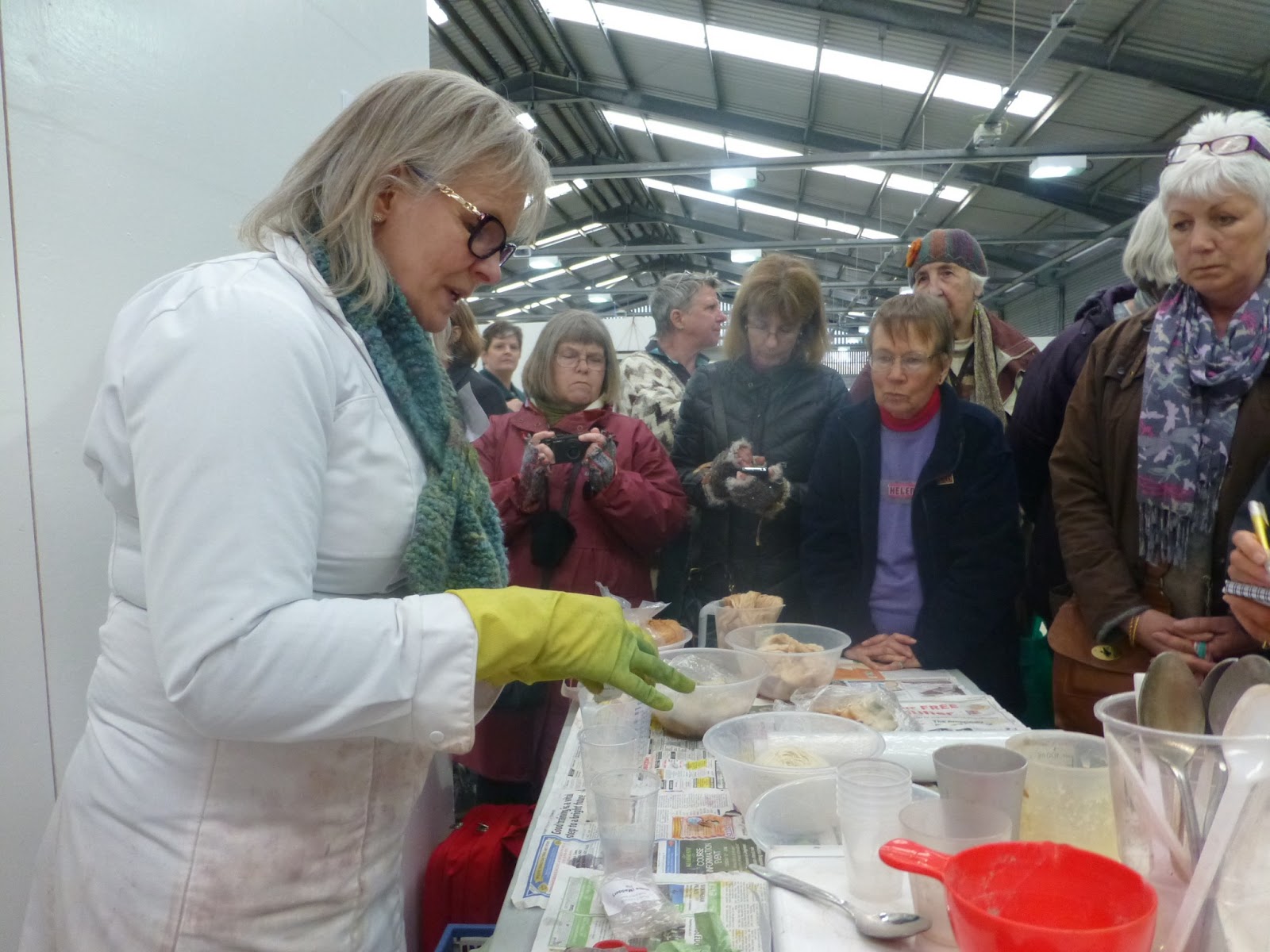 |
| Answering questions... |
 |
| More mixing! |
Thursday, 12 April 2012
Reduce Your Carbon Footprint - spin, weave and dye your own clothes!
Heres another great video, this time about harvesting the humble nettle, like flax, and making your own clothes with it. I was so inspired I bought the book off Amazon and am reading it as I write! It's so interesting and a must read for anyone who is half way into sustainability and reducing their carbon footprint.
Let me know what you think of it... Were you sold? Appalled? It will make an interesting discussion!
Wednesday, 11 April 2012
A Preview of the latest Michel Garcia DVD Workshop
This preview of Michel Garcia's new DVD, Natural Dye Workshop with Michel Garcia - Colour of Provence Using Sustainable Methods, is well worth watching and has prompted me to keep up my work on dyeing sustainably and to try to get a copy of the DVD.
The DVD is approximately 3 hours long, but I'm told by Jane Deane that it's worth watching in bite size pieces to get the most out of it, as it's far to long to sit through in one session. Topics covered included mordants, indigo and woad, printing pastes and printing.
Monday, 9 April 2012
New Indigo Vat Recipes
Last year a group of us went to ISEND, the International Symposium and Exhibition on Natural Dyeing, in La Rochelle, France. While there we went to a workshop with Michel Garcia who was demonstrating his 1-2-3 vat, an eco vat using indigo, calcium hydroxide and fructose. Sadly, I couldn't get close enough to take any notes, but once back, my friend and colleague, Jane Deane managed to go to one of his workshops at the NEC.
Jane has been enthusiastically spreading the word about Michel's new eco-vats, with his blessing, as he want's us all to spread the word too!
So here's my first venture in successful eco-vats, a Banana Vat!

Jane had said that Michel thought we would have difficulty getting very ripe banana's in the UK, but I spotted a large bag of ripe banana's in our local Co-op for 20p. I left them for a couple of weeks so that they were really, really ripe.
 Jane said to mash them really well and cover with hot water from a kettle.
I mashed three of my banana's and covered with 4 litres of boiling water and left for 15 minutes.
 I added 2 level teaspoons of calcium hydroxide (builders lime, which I purchased from Amazon) and approx. 10g of indigo which I got left from Deb Bamford's Indigo Workshop for the Online Guild last September.
I stirred very fast, in small circles in the centre of the vat (not usually the thing to do, but am assured by Jane that Michel broke lots of rules!) until I got the blue foam, then left for about an hour until the copper film, or flower, had formed on the surface of the water. It did begin to form after 20 minutes, but resisted the urge to start dipping.
 On the left is a small cotton hank, a bit patchy because I didn't soak sufficiently in my excitement, pale blue after 1 x 2 minute dip.
In the middle is a cotton hank, dipped twice for 2 minutes at a time.
On the right is a cotton hank, dipped 3 times for 2 minutes at a time.
The blue is much brighter in real life!
 I then added another mashed banana and 2 level teaspoons of lime, heated gently for about 15 minutes, then removed from the heat and left until the flower formed.
I then added several small hand spun wool hanks, including a wool and cashmere hand and a wool and silk hank. All were dipped twice for 2 minutes each time.
Again the camera doesn't show the true blue!
FOOTNOTE: Calcium hydroxide doesn't last long, so only buy small amounts. I got mine from Amazon.
Jane has been enthusiastically spreading the word about Michel's new eco-vats, with his blessing, as he want's us all to spread the word too!
So here's my first venture in successful eco-vats, a Banana Vat!

Jane had said that Michel thought we would have difficulty getting very ripe banana's in the UK, but I spotted a large bag of ripe banana's in our local Co-op for 20p. I left them for a couple of weeks so that they were really, really ripe.

I mashed three of my banana's and covered with 4 litres of boiling water and left for 15 minutes.

I stirred very fast, in small circles in the centre of the vat (not usually the thing to do, but am assured by Jane that Michel broke lots of rules!) until I got the blue foam, then left for about an hour until the copper film, or flower, had formed on the surface of the water. It did begin to form after 20 minutes, but resisted the urge to start dipping.

In the middle is a cotton hank, dipped twice for 2 minutes at a time.
On the right is a cotton hank, dipped 3 times for 2 minutes at a time.
The blue is much brighter in real life!

I then added several small hand spun wool hanks, including a wool and cashmere hand and a wool and silk hank. All were dipped twice for 2 minutes each time.
Again the camera doesn't show the true blue!
FOOTNOTE: Calcium hydroxide doesn't last long, so only buy small amounts. I got mine from Amazon.
Sunday, 19 February 2012
Ellie Marbus Felt Art
We've been sent two stunning images of the art felt garments of Ellie Marbus from the Netherlands.

Ellie previously worked in clay and wax until she discovered felt and the fluidity of nuno felt, this in turn re-ignited her passion for designing and making clothes.
The shawl on the left has been dyed with our indigo and is absolutely stunning.
 We just love this beautiful blouse, again dyed with our indigo.
 Take a look at Ellies Website to see the complete range of her beautifully felted and constructed garments and fashion accessories.
www.elliemarbus.nl

Ellie previously worked in clay and wax until she discovered felt and the fluidity of nuno felt, this in turn re-ignited her passion for designing and making clothes.
The shawl on the left has been dyed with our indigo and is absolutely stunning.


www.elliemarbus.nl
Thursday, 3 November 2011
New Niddy Noddy!
We've got a few new niddy noddy's for sale on our online shop
They are the most beautifully hand made niddy noddy's we've come across and are the creation of Nick Gant in Devon.

The Dam, which takes 1 metre per turn, is priced at £20 and the Lamb, a sample niddy noddy, is £15. They will both be available from 14 November, so put the date in your diary, ready to order!
Left: The Dam in use.

Left: The Dam, in "flat pack" mode!
Thursday, 13 October 2011
Colour Palette of the Month - October!

I was really taken with the autumnal colours, even in August, and the fern just set off the browns, yellows and ochres.
These colours are very "tweed" like and I could see this as a coat fabric with the lime green fern colour as an accent with lime green accessories!
I've been mulling over which dyes I'd use, but thought I'd leave that to you! What do you all think?
Sunday, 11 September 2011
Colour Palette of the Month - September!

The photograph was actually taken way back in March on our annual teaching visit to The Netherlands. The second part of the trip was down in Zeeland near Zierikzee where we had chance to visit the local beach. It was a beautiful sunny, but blustery day and the beach was glinting in the sun, throwing shades of blue and terracotta between the stark white shells.
This is a lovely palette for natural dyeing, so tell me what dyes or dye extracts you'd use and how you'd get the shades? Would you use any modifiers or would you go for the pure dyes?
Thursday, 8 September 2011
Wool Week
Yes, it’s Wool Week, where we celebrate everything wool and the most interesting thing on the new this morning was the increase in the value of wool!
Since foot and mouth in 2001 the number of sheep have declined and as a result the value of the fleece have increased. Most British wool is sent to the Wool Board and is destined for carpets, which is such a shame, as that leave very little for British craftsmen and designers like me. I want British wool, we have the greatest and best range of sheep breeds and wool in the world which enables us to use the right wool for the right fabric.
I know someone who breeds a fabulous breed, the Bowmont, in Devon which rivals the best Merino and the whole clip is sold to make fine British base layer clothing for the active industry! We need more of this fabulous breed here in the UK, so that more fleece is available.
The same person, organised the Exmoor Fleece Fair and I’m told by a textile designer friend that there was the most fabulous Exmoor Horn/Merino cross sheep who’s fleece was to die for and reputed to have a micro count close to 18, although it’s not been tested yet! The organiser said that farmers where shocked that people were prepared to pay an extremely good premium for a quality fleece… Yes, there are lots of us out there who want quality British fleece for fashion and interiors fabrics and most of us know quality when we see it!

Wool cushions
If you’re one of those people who believe that wool is coarse and itchy, then you’ve not tried Merino base layer underwear! Take a look at the Campaign for Wool page and read about the benefits of wool. The variety of wool is truly amazing from the softest to the coarsest, from the most lustrous to the dullest, and everything in between, there really is the most wonderful variety and you should find a breed or cross breed that is suitable for your needs. We just need the farmers to produce the wool we want!
Sunday, 31 July 2011
A really interesting way to Spin
This is a really interesting way to spin those mixed fibres that aren't strong enough on their own!
Wednesday, 6 July 2011
Tuesday, 5 July 2011
Indigo Film Premiers in Santa Fe
What a pity we're in the UK not the US. A new film about indigo was premiered there, on 6 July, featuring Hiroyuki Shindo, a contemporary Japaneses textile artist and master of indigo. The highlight is the filming of the whole process of making and using a fermentation vat.
This lovely little blog give a glimps of what might be expected in the film: http://kyototrip.blogspot.com/2010/10/hiroyuki-shindo-and-little-indigo.html
This lovely little blog give a glimps of what might be expected in the film: http://kyototrip.blogspot.com/2010/10/hiroyuki-shindo-and-little-indigo.html
Friday, 1 July 2011
Colour Palette of the Month - July!
Last September I took my youngest up to Aberdeen University and we stopped by the Winter Gardens in Duthie Park. What an amazing afternoon we spent there and I spent most of that time photographing the plants and flowers.
This months inspiration is one of the many beautiful flowers.

I absolutely adore this colour palette and think it might find it’s way into my new fabric collection to be launched in October. What do you think?
By the way, can any of you identify the flower?
It'll be a challenge to dye with naturals, don't you think, so let me know what dyes you'd use?
Sunday, 5 June 2011
Crochet Artist
At Wonderwool Wales this year the lovely Deborah Allen purchased some of our chunky boucle yarn from the discontinued basket. We can't get anymore of this divine yarn, it's no longer spun, so Deborah bought the lot!
 Since then she's been busy crocheting the yarn into a fabulous jacket and I couldn't resist letting you see her handiwork and the beautiful colours.
Well done, Deborah, your work is truly inspiring.
PS you can get the pattern from Garnstudio
 Since then she's been busy crocheting the yarn into a fabulous jacket and I couldn't resist letting you see her handiwork and the beautiful colours.
Well done, Deborah, your work is truly inspiring.
PS you can get the pattern from Garnstudio
Wednesday, 1 June 2011
Colour Palette of the Month - June!

In March, three colleagues and I were lucky enough to teach a couple of workshops in The Netherlands and between workshops we went to Delft. These vivid tulips and anemones were in a flower shop we passed and we couldn't resist buying them.
What I love about this picture is the contrast in colours and the rich depth. The anemone was slightly more purple than is shown here, but even then it's really gorgeous.
So how would dye these colours? From right to left: 2% lodhra bark to get the lovely soft peach; 5% dhak (tessu flower) and annatto for the vivid yellow; 5% chaste tree and kamala; 5% acacia gum and cutch; 4 dips of indigo; 5% acacia gum over dyed with a couple of dips in indigo.
What would you do?
How would you use these colours?
Monday, 30 May 2011
Learn your ABC with a Dyer!
B is for......
Books! I don't know about anyone else, but I can't do without them. I tend to use them as a resource for trying new techniques, problem solving (there's always an answer somewhere on the bookshelf) and as source of inspiration (often travel, gardening or art books).
I've always got a note book in my bag, as well as a small sketchbook, pen, 2B pencil, rubber, sharpener and very small water colour kit as well as my trusty camera!
Novels are my bedtime reading, not crime, though. I can happily drift off to sleep mid-paragraph.
How about you? What's your favourite natural dyeing book?
Wednesday, 25 May 2011
Learn your ABC with a Dyer!
A is for Anthurium, that waxy flower grown throughout the world and, in particular, Hawaii.
 I first discovered them when I was looking for inspiration for my final project at Bradford College in 2004. The resulting designs and products I’ve woven as a result of the anthurium inspiration have brought me continued recognition.
This little colour palette, that I worked for a yarn I designed for Yarnmaker magazine, features one of my favourite colours.
We could use Red Lac, for the red and the pink and Cutch Waste for the khaki green, what would you use?
Subscribe to:
Posts (Atom)
