Showing posts with label indigo. Show all posts

Wednesday, 11 April 2012

A Preview of the latest Michel Garcia DVD Workshop


This preview of Michel Garcia's new DVD, Natural Dye Workshop with Michel Garcia - Colour of Provence Using Sustainable Methods, is well worth watching and has prompted me to keep up my work on dyeing sustainably and to try to get a copy of the DVD.

The DVD is approximately 3 hours long, but I'm told by Jane Deane that it's worth watching in bite size pieces to get the most out of it, as it's far to long to sit through in one session.  Topics covered included mordants, indigo and woad, printing pastes and printing.

Monday, 9 April 2012

New Indigo Vat Recipes

Last year a group of us went to ISEND, the International Symposium and Exhibition on Natural Dyeing, in La Rochelle, France.  While there we went to a workshop with Michel Garcia who was demonstrating his 1-2-3 vat, an eco vat using indigo, calcium hydroxide and fructose.  Sadly, I couldn't get close enough to take any notes, but once back, my friend and colleague, Jane Deane managed to go to one of his workshops at the NEC.

Jane has been enthusiastically spreading the word about Michel's new eco-vats, with his blessing, as he want's us all to spread the word too!

So here's my first venture in successful eco-vats, a Banana Vat!

Jane had said that Michel thought we would have difficulty getting very ripe banana's in the UK, but I spotted a large bag of ripe banana's in our local Co-op for 20p.  I left them for a couple of weeks so that they were really, really ripe.


Jane said to mash them really well and cover with hot water from a kettle.

I mashed three of my banana's and covered with 4 litres of boiling water and left for 15 minutes.


I added 2 level teaspoons of calcium hydroxide (builders lime, which I purchased from Amazon) and approx. 10g of indigo which I got left from Deb Bamford's Indigo Workshop for the Online Guild last September.

I stirred very fast, in small circles in the centre of the vat (not usually the thing to do, but am assured by Jane that Michel broke lots of rules!) until I got the blue foam, then left for about an hour until the copper film, or flower, had formed on the surface of the water.  It did begin to form after 20 minutes, but resisted the urge to start dipping.


 On the left is a small cotton hank, a bit patchy because I didn't soak sufficiently in my excitement, pale blue after 1 x 2 minute dip.

In the middle is a cotton hank, dipped twice for 2 minutes at a time.

On the right is a cotton hank, dipped 3 times for 2 minutes at a time.

The blue is much brighter in real life!


I then added another mashed banana and 2 level teaspoons of lime, heated gently for about 15 minutes, then removed from the heat and left until the flower formed.

I then added several small hand spun wool hanks, including a wool and cashmere hand and a wool and silk hank.  All were dipped twice for 2 minutes each time.

Again the camera doesn't show the true blue!


FOOTNOTE: Calcium hydroxide doesn't last long, so only buy small amounts.  I got mine from Amazon.
Tuesday, 5 July 2011

Indigo Film Premiers in Santa Fe

What a pity we're in the UK not the US.  A new film about indigo was premiered there, on 6 July, featuring Hiroyuki Shindo, a contemporary Japaneses textile artist and master of indigo.  The highlight is the filming of the whole process of making and using a fermentation vat.


This lovely little blog give a glimps of what might be expected in the film: http://kyototrip.blogspot.com/2010/10/hiroyuki-shindo-and-little-indigo.html

Friday, 6 May 2011

Colour Palette of the Month - May!

Last month I picked an image of a building in The Hague that made me think of rugs for my colour palette inspiration.  However, one or two people thought it was a bit dull for a Spring palette.

This month I've picked a beautiful cornflower image.  I snapped the cornflowers in Rochfort sur Mar while I was on the Wednesday morning excursion at ISEND.

 When trying to replicate the dye colours I'd try:

Green - kamala over-dyed with indigo.
Blue/green - myrobalan over-dyed with indigo.
Bottle green - kamala with two dips in indigo.
Bright blue - five minutes in indigo.
Pale blue - one minute in indigo.
Red - a mix of red lac and kamala.

I hope you like it.  Let me know what you think, does it work for you?  What dyes would you use?

Friday, 4 March 2011

Colour Palette of the Month - March!

I was given this image by Wendy Freebourne, a talented knitware designer from Bath.

The colours are so warm and rich that I couldn't resist using them for this months colour palette.

So what dye extracts would you use for this palette?

I'd give the following extracts a try, from the top:
Black - indigo and an iron modifier.
Khaki green - kamala and a light dip in indigo.
Rust - sappenwood.
Beige - cutch.
Buff - himalayan rhubarb with a copper modifier.

Tuesday, 1 February 2011

Colour Palette of the Month - February!

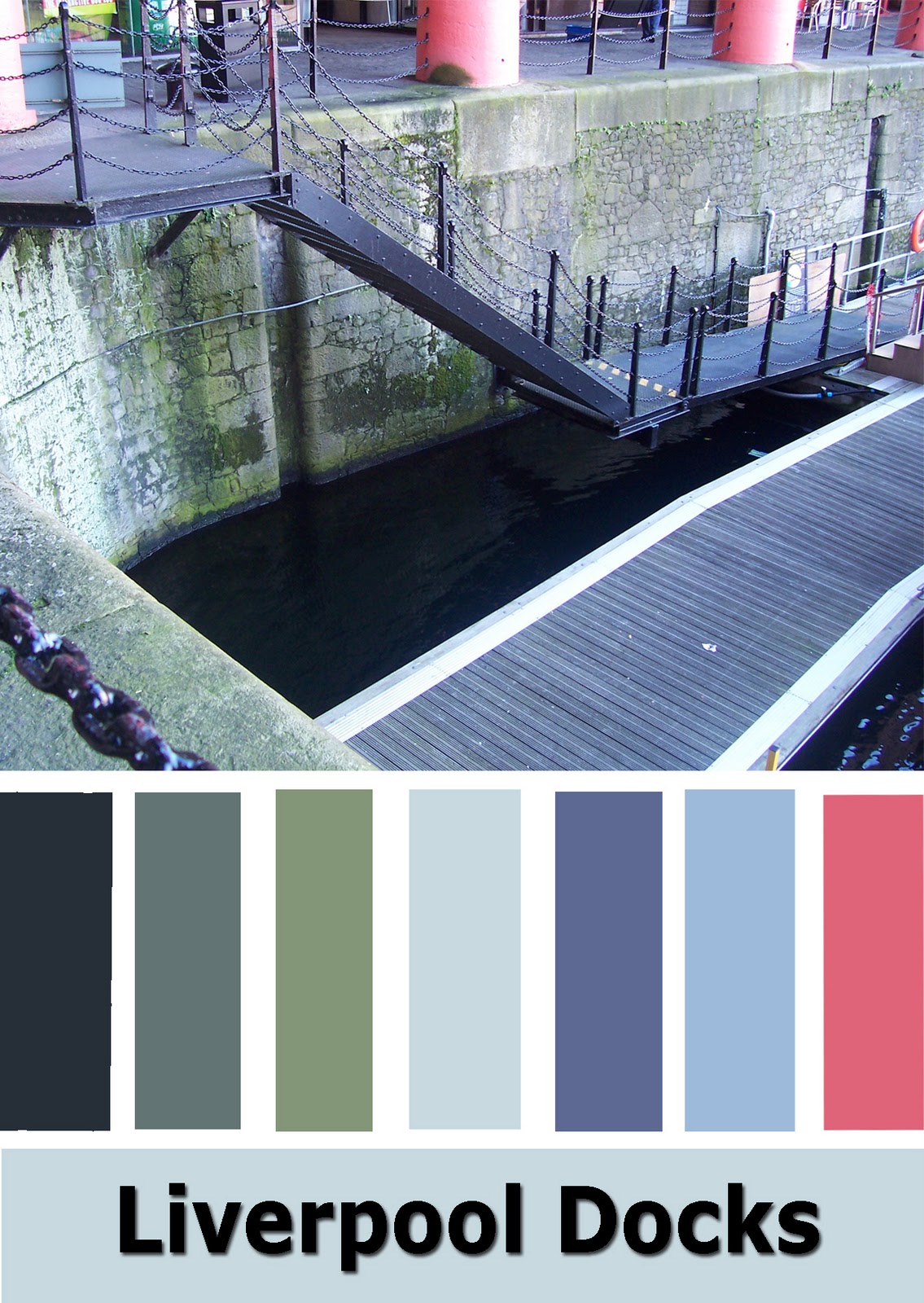
In November I was in Liverpool for a birthday treat.  Obviously a trip to the docks is a must and while there I took this photograph.

Initially it was the shapes that attracted me, but once uploaded to Photoshop the colours caught my eye and following my interest in urban colour I decided to use it for my February colour palette.

How would I recreate the colours in natural dye extracts?

From Left to Right:
Several dips of indigo; a pale yellow, maybe oak gall or 2% kamala with a couple of dips indigo; oak gall or 2% kamala with one light dip of indigo; a very light dip in indigo; two or three dip in indigo; one short dip in indigo and finally a 2% red lac or a mix of red lac and lodhra bark.

How would you recreate the colours?

I hope you enjoy it.

Saturday, 1 January 2011

Colour Palette of the Month - January!

This beautiful bouquet was given to me last year by a friend I'd helped through a difficult period in her life.  I found it so inspiring that I used it for January's colour palette.

Good greens are difficult to obtain in natural dyeing, but I think the left one of the two greens, here, would be produced by using dhak and indigo and the second one might be obtained by modifying with iron water.  The yellow is certainly like dhak and the centre cream colour might be the natural fleece colour or oak gall.

What do you think?

Tuesday, 14 December 2010

Interesting article about Indigo

Take a look at this article on the online magazine, Hand and Eye.  Learn about the symbolism of indigo in the African state of Benin.

Benin Blues - Article

Friday, 29 October 2010

Colour Palette of the Month - November!


Colour Inspirations from Urban Landscapes
At the beginning of October I had a lovely week-end in London.  On the Saturday I wanted to go to the Tate Modern to see the Gaugan Exhibition and decided to walk along part of the Embankment to the Millenium Bridge.
Along the way I came across quite a few juxtapositions of old buildings and new buildings as you can see on the right.  This particular one really caught my eye with the "all glass" building that takes on an indigo colour in the background and the beautiful old building, with it's sand coloured brick and detailing stone work.
How lovely this colour palette would be in natural dyes and weave!  From the top I'd use indigo with an iron modification; indigo on it's own, but dipped several times to build up the deep blue; a very light, quick dip in indigo with a very quick and light modification with iron to get the blue grey; Oak Gall modified with citric acid; cutch.
Mm..... This has really got me thinking!  What about you, what would you use?

Tuesday, 5 October 2010

Colour Palette of the Month - October


Last month I took my daughter to University in Aberdeen, while there we visited the Winter Gardens, a series of Victorian glass houses in Duthie Park south of the city.
I love anthuriums, they are a recurring theme in my work.  They are such strong flowers, strong in form, shape and colour and are the inspiration for this months colour palette. I worked on this palette when we got back from Aberdeen and just before we went to exhibit at 100% Design.  By coincidence one of the strong colours at the show was magenta!
I hope you enjoy this palette with or without the green I’ve added as a contrast.  Green's not an easy colour to get accurately in natural dyes, but it's worth a try to get one of these greens, so try indigo with dhak.  For the magenta try a little purple lac for the pale version at the bottom and with a little copper water for the second from the bottom.  For the dark colour how about trying a short indigo dip with red lac at 4%.

Wednesday, 21 July 2010

Colour Inspirations from Landscapes

A two day break in Anglesey has given me three beautiful colour palettes, one very fresh, one very warm and one a combination of warm and cool.

The first was inspired by the heathland above South Stacks Lighthouse on Holy Island. These fresh colours reflect the low growing heather and gorse.
The yellow could be dyed by using dhak or Himalayan rhubarb root.  The greens could be obtained by over dyeing the same colours with indigo and the pinks could be dyed by a weak solution of red lac and oak gall.


The next palette shows the fabulous earthy colours found on Parys Mountain, near Amlwch, on the north side of the island.
The rich, warm colours lend themselves to natural dyes beautifully.  Oak gall, golden dock, and a weak solution of purple lac lightly over dyed with indigo and oak gall also lightly over dyed with indigo would all be worth trying to obtain the colours.


Finally, these blues and soft beiges were inspired by the beach at Aberffraw on the south of Anglesey.  The blues can be found in indigo and the sand colours could be found in oak gall or sanderswood natural dye extracts.

Sunday, 13 June 2010

Workshop at the Bowland Guild of Weavers, Spinners and Dyers

On May Day I was at the Bowland Guild in Lancashire to tutor a workshop using Pure Tinctoria natural dye extracts.  It was a lovely day weather wise and proved to be a lovely day teaching wise, too!


I was amazed at the number of people attending, I usually limit the numbers to 10, but they were prepared to bring more electric hot plates and additional pots, so we had at least 16!  And with the remainder of the guild spinning at the far end of the room, away from our hot plates, the room was packed.  Obviously Health and Safety came into very strict play, to prevent any accidents and everyone was really patient waiting their turn to weight dyes and yarns/fibres.


Here are a selection of pictures that the guild took at one of their meeting the following month which shows what a fabulous range of yarns were produced that day.
Yarns ranged from handspun to commercial, fine to chunky, plain to boucle!


We did centre pull ball dyeing using two colours, painted yarns and fibres and indigo!
There were fibres including tops and home produced alpaca and mohair.
And every colour of the rainbow was produce.

All in a day!

Amazing!

Tuesday, 4 May 2010

Naturally Dyed Rug by Janet Walker

One of Jane Deane's spinning and weaving students has handspun and dyed her yarn for a beautiful rug.

Janet used indigo, purple lac, red lac, madder and a yellow (that Jane couldn't remember!) all from the Pure Tinctoria range.

Take a look at the image on the right to see her fabulous result.

Monday, 10 November 2008

Gift Idea No. 5!

Hello again.

I've had some lovely results with my indigo over the summer and you may have seen my centre pull ball and twisted hank experiments. I've woven the two, 100g centre pull balls into lovely large scarves with some indigo dyed boucle. They could be knitted rather than woven if you prefer, but they are really lovely and quite simple to dye using the Jenny Dean "Colour Run Remover" method!

With this in mind why not buy a pack of indigo and a hank of Blue Faced Leicester Chunky Texture Yarn and we'll add the instructions for dyeing with the centre pull balls or twisted hank and throw in a knitting pattern, crochet pattern and weaving instructions for a Knitters Loom (rigid heddle loom), too!

Wednesday, 2 July 2008

More Indigo!

Here are the images of the centre-pull ball dyeing I did in the same indigo vat.


I already had some centre-pull balls wound tightly and only had to "wet them out". I then put a rod (long paint brush) through the centre and allowed the ball to just sit in the vat.

After about 5 minutes I flipped the ball over and let the other side sit in the vat, as you can see in the image on the left.


Here you can see the distinct areas of colour.


Below is onen of the hanks hanging on the line after washing and rinsing.


I did manage to warp two knitters loom with these yarns before I went to Woolfest, but didn't manage to do much weaving while I was there. I did finish the weaving at home on Sunday, by way of a rest! I will post images of those when I manage to find time to photograph them.

Indigo

Just before I want to Woolfest I tutored a dye workshop. During the course of the week-end we did some indigo dyeing. I love wool, so naturally I had lots of hanks of yarn, including some lovely Blue-faced leicester gimp.

I had some in hanks and some in centre-pull ball, so in a quiet moment I managed to "dunk" them in the indigo vat.

The first ones to go in where the hanks, which I tightly hanked, giving them a really good twist, until I couldn't twist any more. I then gave them a good wetting out, followed by a good squeeze and placed them one at a time in my vat. I pushed them carefully under the surface then allowed the hank to bob back to the surface.


The image on the left shows, clearly, the coppery coloured film of a vat that is in good order.


Carefully removing the hank, catching any drips in a jug, I allowed the hank to oxydise briefly, before unwinding and hanging on the line to fully oxydise. The image on the right shows the hank as I unwound it before hanging on the line.


Here is the hank hanging on the line to dry after washing and rinsing, with a final rinse with a small amount of vinegar in the water.
Related Posts Plugin for WordPress, Blogger...